Home
Training Providing Family PACT Services During COVID-19 Part 1: Clinical Considerations
Providing Family PACT Services During COVID-19 Part 1: Clinical Considerations
May 8, 2020
Since March 2020, most providers of family planning services in California have shifted patient care from in-person visits to remote visits. This webinar will be conducted in a “frequently asked questions” format, focusing on the adaptations that clinicians should make in order to successfully provide family planning care remotely during the public health emergency and afterward.
The following topics are covered in detail:
Subjects will include the role of blood pressure measurement before prescribing combined hormonal contraception
The use of injectable birth control subcutaneous depot medroxyprogesterone acetate (DMPA-SQ)
Syndromic treatment of sexually transmitted infections
Pregnancy testing without a clinic visit.
Recently enacted Family PACT and Medi-Cal policies regarding telehealth visits and remote enrollment of clients into the Family PACT program.
This webinar features two new Family PACT Clinical Practice Alerts.
Cervical Cancer Screening
Topics in this portion of the webinar will include benefits through Family PACT that have been expanded to include high-risk HPV-alone screening, use of this test, alternative cervical cancer screening options, and new guidelines regarding cervical cancer screening for females who are HIV positive or who are immunocompromised.
Emergency Contraception
Topics in this portion of the webinar will include the relationship between body weight and emergency contraception failure rates, when oral contraceptives can be started with females who have used ulipristal acetate, options for accessing emergency contraceptive pills and the use of the copper IUD as emergency contraception.
Home
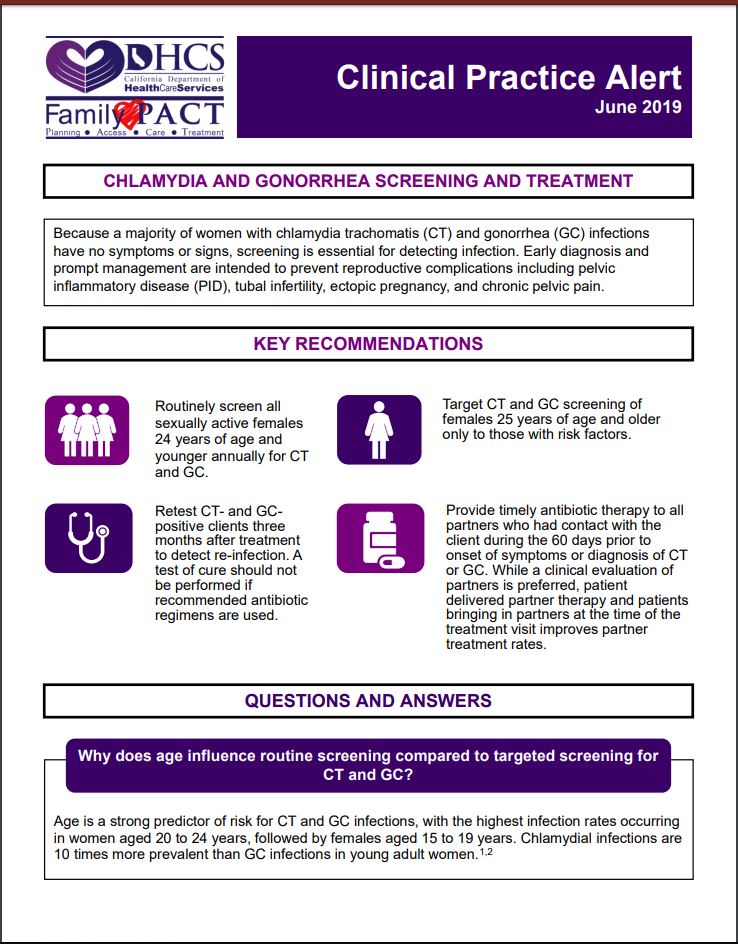
Training Clinical Practice Alert: Chlamydia and Gonorrhea Screening and Treatment
Clinical Practice Alert: Chlamydia and Gonorrhea Screening and Treatment
June 20, 2019
Rates of sexually-transmitted diseases (STDs) such as chlamydia trachomatis (CT) and gonorrhea (GC) have reached an all-time high. In the U.S., California leads the nation in reported cases of these STDs. Because persons with CT and GC are often asymptomatic, screening is essential for the early detection and treatment that can prevent reproductive complications including pelvic inflammatory disease (PID), tubal infertility, ectopic pregnancy, and chronic pelvic pain in females and epididymitis in males.
This webinar covers current clinical guidelines for routine and targeted screening, treatment, follow-up, and prevention of CT and GC.
Learning objectives:
Understand current guidelines for screening for CT and GC among sexually active women and men
List the indications for anorectal and oropharyngeal CT/GC screening
Explain when test-of-cure is indicated
Identify the proper ICD-10 codes for lab requests and billing information
Home
Training Pain Management: Tips, Tricks, and Evidence
Pain Management: Tips, Tricks, and Evidence
February 5, 2019
Patients often experience varying levels of pain or discomfort from procedures performed during family planning visits. The purpose of this webinar is to provide clinicians with evidenced-based tips, tricks, and strategies on how to prevent and minimize pain during family planning procedures.
The webinar focuses on the most commonly performed family planning procedures such as: IUD insertion/removal, implant insertion/removal, colposcopy, biopsy, and vulvar biopsy. Less common procedures for non-gynecologists such as LEEP, cryo, and procedures not covered by the Family PACT Program are not discussed.
The following topics are covered in detail:
Three components and factors associated with procedure pain and strategies to alleviate discomfort
Four examples of trauma-informed care practices for family planning clients
Three examples of ways to use patient-centered language during pelvic exams
Considerations for administering and providing the appropriate level of local anesthetic
Home
Training Prevention and Management of IUD Complications
Prevention and Management of IUD Complications
October 4, 2018
The purpose of the webinar is to provide clinicians who are doing IUD placements with advanced skills to prevent and manage the uncommon complications that can occur with the placement and use of IUDs. It consists of case studies that detail the management of difficult IUD placements owing to cervical stenoisis, morbid obesity, and vasovagal syncope. Management of IUD complications, including uterine perforation, tenaculum site injuries, and post-IUD placement infection will be discussed. The work-up and management of the patient with a “missing” IUD string, including variants of malpositioned IUDs and intrauterine pregnancy with an IUD in place, are explained as well.
The following topics are covered in detail:
Maneuvers that can be performed to improve the likelihood of successful placement in morbidly obese patients
Techniques to avert vaso-vagal episodes and 4 sequential steps in the management of a vaso-vagal syncope
The most common predisposing factors for uterine perforation with IUD placement
Causes of a “missing” IUD string and how each is managed
Management of post-IUD placement pelvic inflammatory disease
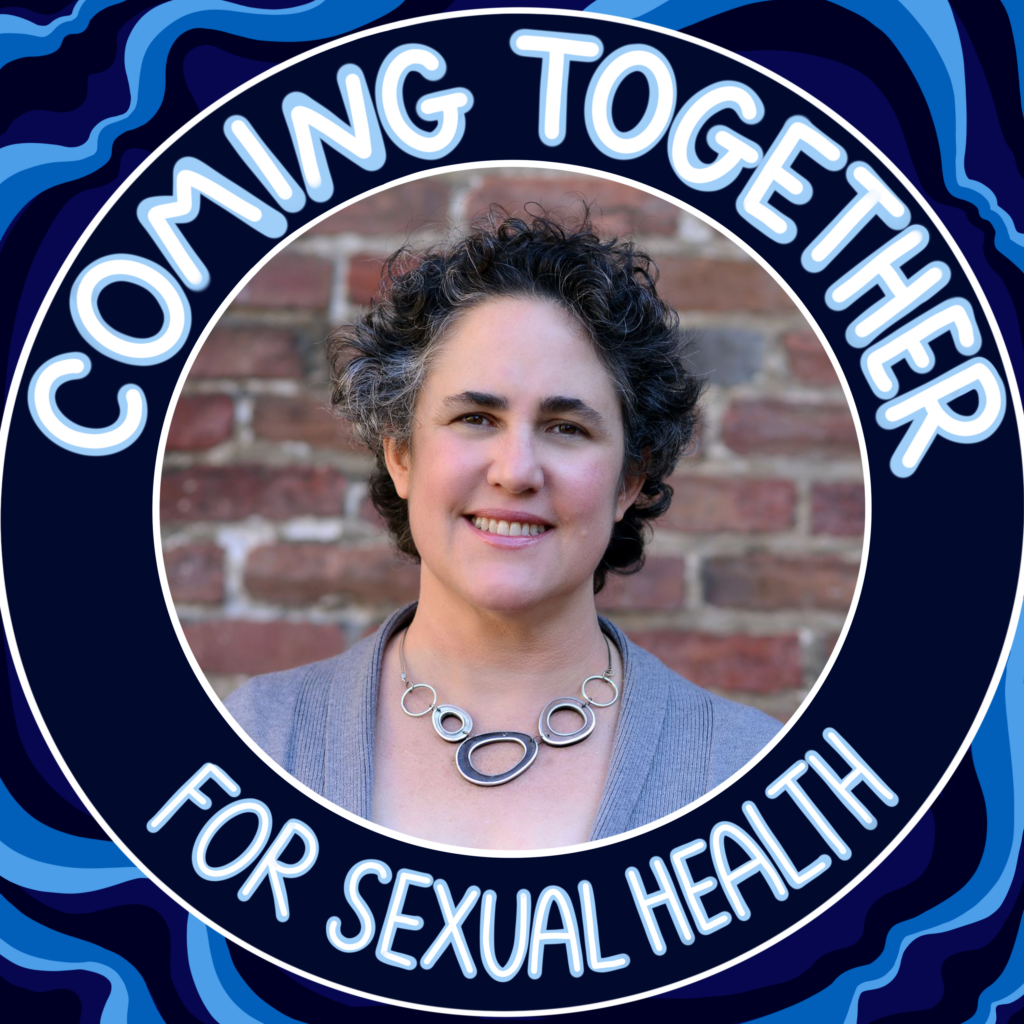
Welcome to our mini-series on Reproductive Justice and Family Planning! Diana Greene Foster, PhD, author of The Turnaway Study: Ten Years, a Thousand Women, and the Consequences of Having – or Being Denied – an Abortion, sits down with host Tammy Kremer to advocate for reproductive justice and bodily autonomy. She explains that the Turnaway Study found that, “When people are making the decision about what to do with an unexpected pregnancy and they decide on abortion, all the reasons they give us are exactly those outcomes that we see for people who are denied an abortion.” She envisions a world in which “everyone is an equal partner in sex, in childbearing, in contraception, in pregnancy decision-making.”
Turn on notifications to never miss an episode of Coming Together for Sexual Health.
Follow Coming Together for Sexual Health on Instagram and Twitter.
Diana Greene Foster is a professor at the University of California, San Francisco, in the Department of Obstetrics, Gynecology, and Reproductive Sciences and a researcher at Advancing New Standards in Reproductive Health. She is the principal investigator of the Turnaway Study in the United States and Nepal, a nationwide longitudinal prospective study of the health and well-being of women who seek abortion including both women who do and do not receive abortion.
The contents of the well-woman visit have changed significantly in the past decade, such that many screening tests are performed in modified age groups and at different screening intervals. This webinar will review the well-woman health screening recommendations published by the California Department of Public Health (CDPH), U.S. Preventive Services Task Force (USPSTF), American College of Obstetrics and Gynecology (ACOG) and other national organizations.
The following topics are covered in detail:
Reproductive goals counseling
Use of newer cervical cancer screening technologies
Utility of screening clinical breast exams and screening pelvic exams
Becca Schwartz, LCSW, speaks about Team Lily, a pregnancy clinic for people experiencing significant barriers to care located at Zuckerberg San Francisco General Hospital. We focus on trauma-informed care: how past trauma can show up for patients in the medical setting, ways providers can practice trauma-informed care, and how these issues present and are addressed in San Francisco and specifically at the Team Lily clinic. We’d like to note that this episode contains occasional gendered language when talking about pregnant people. We recognize that not all pregnant people identify as women. Download the transcript of this episode.
Stop the Hidden Epidemic: Five Steps to Prevent and Treat HIV, HCV, and STDs Among People Experiencing Homelessness, from the CAPTC
Turn on notifications to never miss an episode of Coming Together for Sexual Health.
Follow Coming Together for Sexual Health on Instagram and Twitter.
Becca Schwartz has been working as a clinical social worker at San Francisco General Hospital since 2004, in a joint position with the HIV Division and the Department of OB/Gyn. In 2018 she helped to launch Team Lily, a low-barrier pregnancy care clinic for people experiencing barriers such as homelessness, substance use disorders, mental illness, and intimate partner violence. As the social worker for HIVE Clinic and Team Lily, she provides complex care coordination, psycho-social support, risk reduction counseling, and linkage to mental health and substance use treatment to women living with HIV, or at risk for HIV, in and around pregnancy. For the past 15 years, Becca has provided these clinical services as well as practical help accessing housing and homeless services, healthcare, financial and nutritional benefits to pregnant women and their families. Becca is trained in Infant-Parent psychotherapy and brings this clinical lens to her work with families.
Home
Training Family Planning Minute – Insurance Affordability Programs (Providers)
Family Planning Minute – Insurance Affordability Programs (Providers)
August 19, 2016
Are you a Family PACT provider with patients struggling to afford health insurance? Learn more about how you can help clients apply for affordable low or no-cost health insurance options through Covered California. It is the market place where clients can shop and compare health insurance plans and even find out if they qualify for discounts for private insurance. Help make sure your clients get the coverage they need to access the care they deserve.
Home
Training Zika Virus: Implications for Family Planning
Zika Virus: Implications for Family Planning
June 29, 2016
The Zika virus is an emerging concern for the health of women who are pregnant or may become pregnant. This webinar discusses the unique role that providers play in keeping women healthy.
The following health concerns of the Zika virus are covered in detail:
The epidemiology, transmission, and implications for women’s family planning needs for Zika virus
Use principles of shared decision-making to counsel women at risk of Zika infection about family planning options
Review resources for family planning clinicians about the Zika virus
By clicking this box, you agree to use these videos for training and educational purposes only. Do not copy, download, share, or distribute the content. These materials may not be uploaded or used in artificial intelligence or machine learning systems.
We use cookies to ensure that we give you the best experience on our website, but we also recognize the right to privacy. Please accept or disable cookies for this website.