How to Prescribe Expedited Partner Therapy (EPT) for Sexually Transmitted Infections
Expedited Partner Therapy (EPT) is the clinical practice of treating sex partners of patients diagnosed with certain sexually transmitted infections (STIs) – including chlamydia (CT), gonorrhea (GC), and trichomoniasis – without the health care provider first examining the partner(s). EPT usually involves patient delivered partner therapy (PDPT), in which the patient delivers the medication or a prescription to their partner(s). While evaluating the partner and providing other needed health services would be ideal, this is often not feasible. EPT can be provided confidentially; it is effective, safe, acceptable to patients and partners, and helps to ensure timely partner treatment.
This resource contains information on how to prescribe EPT in California, including sample prescriptions, information on billing/reimbursement, and patient-facing materials.
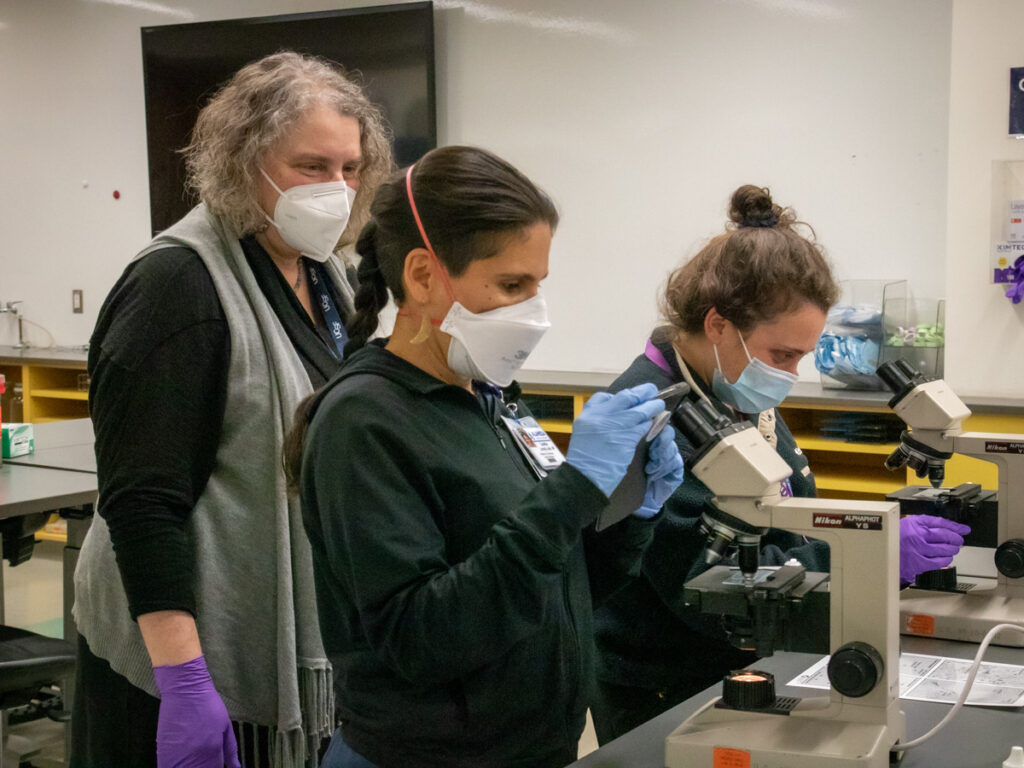
Examination and Interpretation of Wet Preparations of Vaginal Specimens
In-person laboratory course onsite at the UC San Francisco campus
Intended for practicing clinicians with prior wet mount experience and microscopy skills
Capacity limited to 8 persons
The course begins with a fifteen minute didactic presentation on applicable issues of CLIA regulation, quality control, and interpretation vaginal wet mount (VWM) for common causes of vaginitis. This will be followed by a fifteen minute video that details through the microscope footage of findings on VWM including trichomads, yeast and clue cells associated with BV. The remaining two and one-half hours consists of experiential training, including laboratory practicum on examination of saline and KOH vaginal wet mounts (VWM). During this portion of the training, participants will have an opportunity for group discussion, explanation, and demonstration, as well as practice and return demonstration.
Learning Objectives
Practice proper preparation of saline and KOH specimens of vaginal fluid to increase viability of specimens for microscopic evaluation.
Perform proper use of the light microscope to improve examination of saline and KOH wet mount specimens.
Assess wet mount microscopy specimens to appropriately interpret findings that support diagnosis of vulvovaginal candidiasis, bacterial vaginosis or trichomoniaisis.
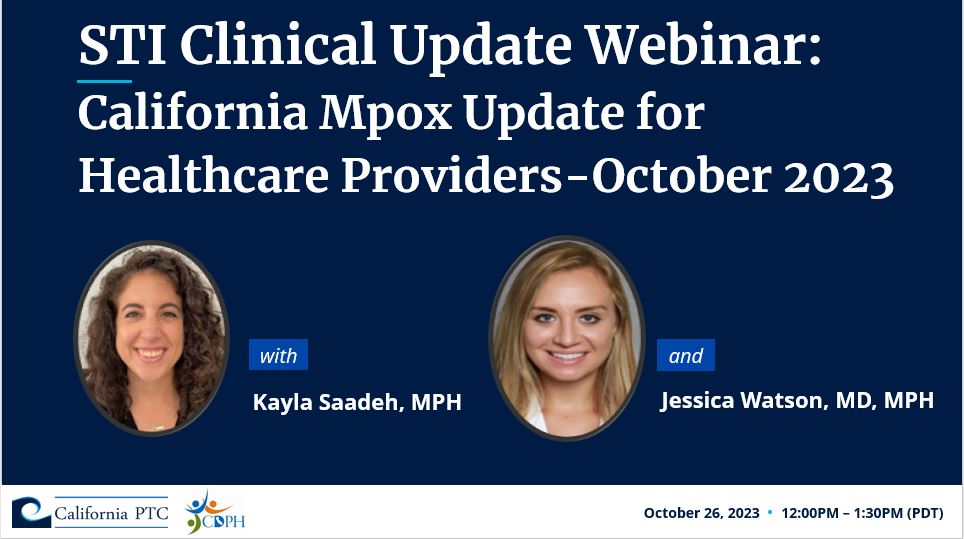
STI Clinical Update Webinar: California Mpox Update for Healthcare Providers – October 2023
Thursday, October 26, 2023 12:00 PM – 1:30 PM (PDT)
The California Department of Public Health (CDPH) continues to see statewide Mpox activity, including a large cluster in Los Angeles County. This webinar, presented by the California Prevention Training Center (CAPTC), features CDPH’s Mpox Clinical and Epidemiology teams, who will provide a clinical update and epidemiological overview of Mpox, and discuss new research findings relevant to primary care and other healthcare providers, including data on transmission, vaccine equity, and vaccine effectiveness. A question-and-answer session will follow.
Presented by:
Kayla Saadeh, MPH Mpox Epidemiology Unit Lead California Department of Public Health
Jessica Watson, MD, MPH Mpox Public Health Medical Officer and Acting Clinical Lead California Department of Public Health
Learning Objectives
Identify the clinical and epidemiological factors leading to Mpox infection, transmission, and severity as well as treatment options.
Apply the latest information and research on Mpox, including transmission characteristics, vaccine equity, and vaccine effectiveness, to your clinical practice to ensure patients are appropriately vaccinated, diagnosed, tested, and treated for Mpox.
Please note: CME not available for viewing the webinar recording.
What, how, and why to talk to your clients about Doxy-PEP.
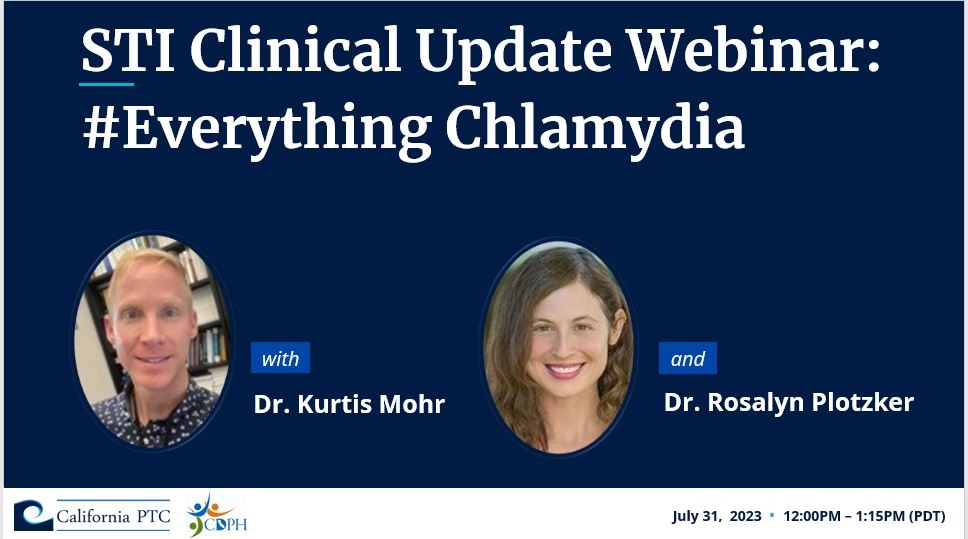
Presented by Drs. Kurtis Mohr and Rosalyn Plotzker
Registration for CME purposes closes three days before the webinar. After that time, you will be able to join the webinar, but you will not be able to get CME.
Chlamydia is an STI that can manage to damage our body in oh so many places. Watch this webinar to learn Everything about this “cloaked” assailant: from stats & numbers, to pathophys’, fevers, chills, and burning whiz! Plus screening, treatment & prevention, of course!
Learning Objectives
Recognize the different sequelae of sexually transmitted C. trachomatis and their recommended treatments
Know the recommended screening strategies C. trachomatis
Meet our Experts
Kurtis Mohr, MD, AAHIVM Dr. Mohr is a Family Medicine trained physician and recent 2022 graduate from Kaiser Permanente’s HIV Fellowship Program. He joined the California Department of Public Health in November 2022 as a Public Health Medical Officer in the STD Control Branch. His work focuses on preventative measures such as DoxyPEP and Hepatitis B & C screening outreach, along with Disseminated Gonococcal Infection (DGI) investigations.
Rosalyn Plotzker, MD, MPH Dr. Plotzker is an Assistant Professor in the UCSF Department of Epidemiology and Biostatistics. She completed a Fellowship in Sexually Transmitted Diseases with the CAPTC and CDPH. She serves as a Public Health Medical Officer in the STD Control Branch at CDPH.
May 2023 Is PrEP for Me: Addressing PrEP Disparities for Black People (Part 2)
Home
Training Examination and Interpretation of Wet Preparations of Vaginal Specimens
Examination and Interpretation of Wet Preparations of Vaginal Specimens
Intended for Practicing Clinicians with Prior Wet Mount Experience
The course begins with a fifteen minute didactic presentation on applicable issues of CLIA regulation, quality control, and interpretation vaginal wet mount (VWM) for common causes of vaginitis. This will be followed by a fifteen minute video that details through the microscope footage of findings on VWM including trichomads, yeast and clue cells associated with BV. The remaining two and one-half hours consists of experiential training, including laboratory practicum on examination of saline and KOH vaginal wet mounts (VWM). During this portion of the training, participants will have an opportunity for group discussion, explanation, and demonstration, as well as practice and return demonstration.
Learning Objectives
Practice proper preparation of saline and KOH specimens of vaginal fluid to increase viability of specimens for microscopic evaluation.
Perform proper use of the light microscope to improve examination of saline and KOH wet mount specimens.
Assess wet mount microscopy specimens to appropriately interpret findings that support diagnosis of vulvovaginal candidiasis, bacterial vaginosis or trichomoniasis
March 30, 2023 from 2:00PM – 5:00PM (PDT)
UCSF Parnassus Heights Campus: San Francisco, CA
Instructors: Sharon Adler, MD, MPH and Lee Fagen, NP
A free educational website from the University of Washington STD Prevention Training Center.
By clicking this box, you agree to use these videos for training and educational purposes only. Do not copy, download, share, or distribute the content. These materials may not be uploaded or used in artificial intelligence or machine learning systems.
We use cookies to ensure that we give you the best experience on our website, but we also recognize the right to privacy. Please accept or disable cookies for this website.