STI Clinical Update Webinar – Introduction to Syphilis and Congenital Syphilis: A Phoenix IHS and CAPTC Event
January 11, 2024
8:30AM-12:00PM (MST)
Presented by CAPTC Clinical Faculty
Please note: CME not available for viewing the webinar recording.
Presenters:
Sharon Adler, MD, MPH, Clinical Faculty, California Prevention Training Center
Wyatt Hanft, MD, MPH, AAHIVS, STI Fellow, California Prevention Training Center
Tamara Ooms, RN, MSN, FNP, Program Manager, California Prevention Training Center
Ina Park, MD, MS, Principal Investigator, California Prevention Training Center
Rosalyn Plotzker, MD, MPH, Clinical Faculty, California Prevention Training Center
Moderator: Kelly Johnson, MD, MPH, Medical Director, California Prevention Training Center
Learning Objectives:
Describe the varied clinical manifestations of syphilis in adults & congenital syphilis (CS) in infants
Recognize that there are two different screening algorithms used to diagnose syphilis in adults
Define adequate treatment for syphilis, including during pregnancy
List at least 3 strategies to prevent syphilis in adults and infants
STI Expert Hour Webinar – Navigating the Bicillin L-A Shortage: A Conversation with PharmD Dr. Kathy Yang
January 31, 2024
12:00PM-1:15PM (PST)
1.25 CME units at no cost
Please note: No CME available for viewing the webinar recording.
Learning Objectives
List at least 2 factors contributing to ongoing Bicillin L-A shortages
Describe a framework for prioritizing Bicillin L-A when supplies are limited
Name potential alternative treatments for syphilis in non-pregnant people
Develop a decision-making process for the treatment of syphilis when standard guidelines cannot be followed or when data is insufficient.
Meet Our Expert: Kathy Yang, PharmD, MPH
Dr. Yang is a Health Sciences Clinical Professor in the Department of Clinical Pharmacy and the Co-Vice Dean of Clinical Innovation and Entrepreneurship at the University of California, San Francisco School of Pharmacy. She is also an Infectious Diseases Clinical Pharmacist in the UCSF Medical Center. Dr. Yang specializes in pharmacokinetic and pharmacodynamic optimization of the treatment of multi-drug resistant infections, particularly gram-negative bacteria such as Pseudomonas aeruginosa. For the past 3 years, Dr. Yang has focused her efforts on the clinical management of COVID-19.
STI Clinical Update Humboldt County-Addressing the Rise of Syphilis: A Review of Clinical Management of Syphilis and Congenital Syphilis for Health Care Providers
Presented by Drs. Kathleen Jacobson and Wyatt Hanft
Describe the stages of syphilis and the recommended treatment and follow up for people with syphilis
Compare the traditional and reverse algorithm for syphilis screening
Please note: CME not offered for viewing the recording of the update
August 30, 2023
Description:
Exposure to abuse, neglect, discrimination, violence, and other adverse experiences can greatly impact a person’s health for the long term and the way they interact with the healthcare system especially when it comes to family planning services. Because of the potentially long-lasting negative impact of trauma on physical and mental health, it’s important for providers to understand and incorporate trauma-informed approaches to care into their practice.
Trauma-informed care acknowledges the need to understand a client’s life experiences to deliver effective care and has the potential to improve patient engagement, treatment adherence, and health outcomes. This webinar will go over strategies for integrating trauma-informed practices into reproductive health services.
Learning Objectives:
Define various types of traumas frequently experienced by people accessing reproductive health services
Identify trauma-informed practices that can be used in clinical settings
Describe the role of self-care and team-based care in providing trauma-informed services
Speaker:
Dominika Seidman, MD, MAS OBGYN and associate professor at San Francisco General Hospital Co-founded Team Lily, a trauma-informed, multidisciplinary care team providing wrap-around services to pregnant people Provides reproductive health services at the San Francisco County Jail
According to the National Survey of Family Growth, approximately 12% of “women of childbearing age” have a disability, and yet our educational and training programs devote little to no time in preparing us to provide accessible, appropriate, quality services to these populations. This webinar will define the population, identify the sexual and reproductive health needs, barriers to health care and health care disparities for people with disabilities, and present best practices for providing accessible, equitable sexual and reproductive health care for people with disabilities. This webinar will also discuss actionable items providers can immediately implement in their practices to make them disability accessible.
Learning Objectives:
Develop an inclusive definition of the populations that comprise people with disabilities
Identify sexual and reproductive health needs, barriers to health care and healthcare disparities for people with disabilities
Outline best practices for providing sexual and reproductive health care for people with disabilities
Identify concrete actions providers can take to improve access to and quality of sexual and reproductive health care for people with disabilities
Become knowledgeable on language, culture, and medical equipment suggestions
Speakers:
Erica Monasterio, MN, FNP-BC-Retired Clinical Professor Emerita at University of California, San Francisco 35 years of clinical experience in primary care for youth and families at UCSF and the San Francisco Department of Public Health Works in collaborations with organizations at the local, state, and national level providing training and technical assistance
Robin Wilson-Beattie, B.A Disability Sexual and Reproductive Health Educator Certified by the American Board of Sexology and City College of San Francisco as a Sexual Health Educator Member of the American Association of Sexuality Educators, Counselors and Therapists (AASECT), the Women of Color Sexual Health Network (WOCSHN), and a graduate of the San Francisco Sexuality Information Training (SFSI) Sex Educator Training Speaker, writer, and advocated for disability and sexuality
This page houses PrEP Learning Collaborative videos and slides from 03/2022 to 09/2024. Sessions occurring after 09/2024 will be entered individually as resources.
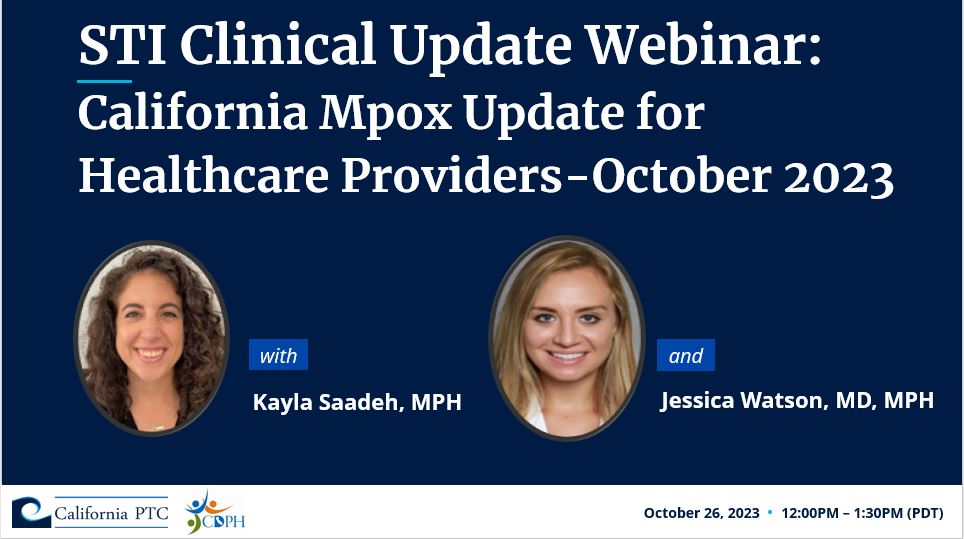
STI Clinical Update Webinar: California Mpox Update for Healthcare Providers – October 2023
Thursday, October 26, 2023 12:00 PM – 1:30 PM (PDT)
The California Department of Public Health (CDPH) continues to see statewide Mpox activity, including a large cluster in Los Angeles County. This webinar, presented by the California Prevention Training Center (CAPTC), features CDPH’s Mpox Clinical and Epidemiology teams, who will provide a clinical update and epidemiological overview of Mpox, and discuss new research findings relevant to primary care and other healthcare providers, including data on transmission, vaccine equity, and vaccine effectiveness. A question-and-answer session will follow.
Presented by:
Kayla Saadeh, MPH Mpox Epidemiology Unit Lead California Department of Public Health
Jessica Watson, MD, MPH Mpox Public Health Medical Officer and Acting Clinical Lead California Department of Public Health
Learning Objectives
Identify the clinical and epidemiological factors leading to Mpox infection, transmission, and severity as well as treatment options.
Apply the latest information and research on Mpox, including transmission characteristics, vaccine equity, and vaccine effectiveness, to your clinical practice to ensure patients are appropriately vaccinated, diagnosed, tested, and treated for Mpox.
Please note: CME not available for viewing the webinar recording.
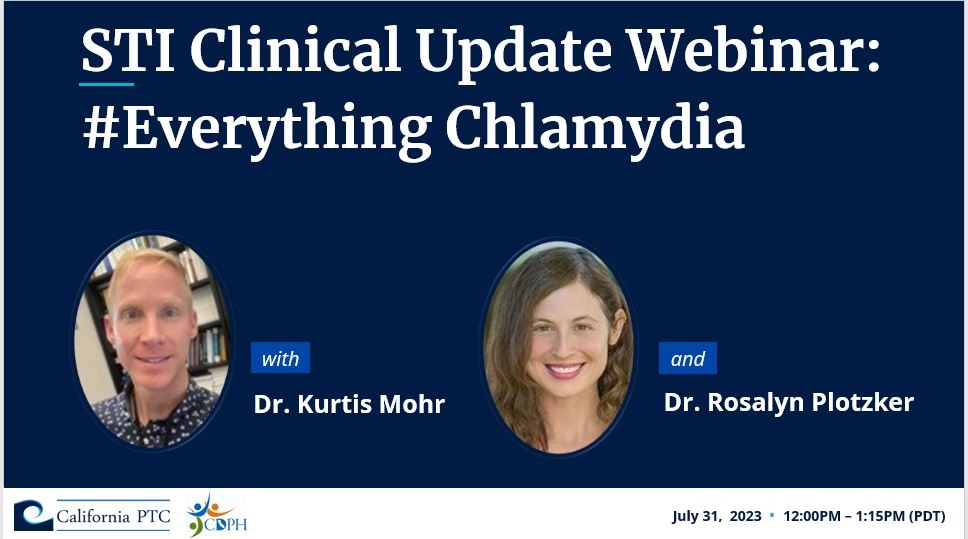
Presented by Drs. Kurtis Mohr and Rosalyn Plotzker
Registration for CME purposes closes three days before the webinar. After that time, you will be able to join the webinar, but you will not be able to get CME.
Chlamydia is an STI that can manage to damage our body in oh so many places. Watch this webinar to learn Everything about this “cloaked” assailant: from stats & numbers, to pathophys’, fevers, chills, and burning whiz! Plus screening, treatment & prevention, of course!
Learning Objectives
Recognize the different sequelae of sexually transmitted C. trachomatis and their recommended treatments
Know the recommended screening strategies C. trachomatis
Meet our Experts
Kurtis Mohr, MD, AAHIVM Dr. Mohr is a Family Medicine trained physician and recent 2022 graduate from Kaiser Permanente’s HIV Fellowship Program. He joined the California Department of Public Health in November 2022 as a Public Health Medical Officer in the STD Control Branch. His work focuses on preventative measures such as DoxyPEP and Hepatitis B & C screening outreach, along with Disseminated Gonococcal Infection (DGI) investigations.
Rosalyn Plotzker, MD, MPH Dr. Plotzker is an Assistant Professor in the UCSF Department of Epidemiology and Biostatistics. She completed a Fellowship in Sexually Transmitted Diseases with the CAPTC and CDPH. She serves as a Public Health Medical Officer in the STD Control Branch at CDPH.
STI Expert Hour Webinar: Results of the ANCHOR study and their implications for anal cancer prevention guidelines
June 27, 2023 from 11:30AM-12:45PM (PDT)
Presented by Drs. Cristina Brickman and Joel Palefsky
This webinar will summarize the epidemiology of anal cancer, the results of the ANCHOR Study and development of guidelines for prevention of anal cancer in people living with HIV.
Learning Objectives:
Recognize the groups at highest risk of anal cancer
Explain the main findings of the ANCHOR Study
Explain current approaches to prevention of anal cancer
Please note: No CME available for viewing the webinar recording
May 2023 Is PrEP for Me: Addressing PrEP Disparities for Black People (Part 2)
By clicking this box, you agree to use these videos for training and educational purposes only. Do not copy, download, share, or distribute the content. These materials may not be uploaded or used in artificial intelligence or machine learning systems.
We use cookies to ensure that we give you the best experience on our website, but we also recognize the right to privacy. Please accept or disable cookies for this website.